

Many of the parks in the city are the grounds of former villas that are now public. This week we visited two large parks that are further out. The first one is the Parco degli Acuedotti (and here) located South and East of the city center. It isn't that far away, but it feels delightfully wild after being in the concrete urban jungle for awhile. Not that long ago this area was wild. The buildings in the surrounding neighborhood were built during the post WWII suburban building boom. But true to form this park includes an ancient villa, Villa delle Vignacce, Villa of the vineyards, built in the 2nd century and restored in the 4th century. More recent 21st century excavations revealed mosaics, baths, and an underground heating system.

The stars of the park are the aqueducts which were used to carry water into the city. There are three running through the park in various states of disrepair. One of them was partly dismantled by Pope Sixtus to build a different aqueduct in another part of the city.


Parts of the Via Latina are still visible in the park, one of the oldest Roman roads. This ancient road leads out of the city from the Porta Latina. Porta Latina is a smaller gate in the old city walls near our house and just south of the Baths of Caracalla. My Boy walks through this gate on his way home from school.
We were there at sunset, which was a beautiful time of day. I really enjoy the winter light. It is a lot like winter in California, just a little bit colder. The November rains have stopped and the spring rain hasn't started yet, so it's gorgeous.


This is not a black and white photo. For some reason it makes me think of Lemony Snicket.

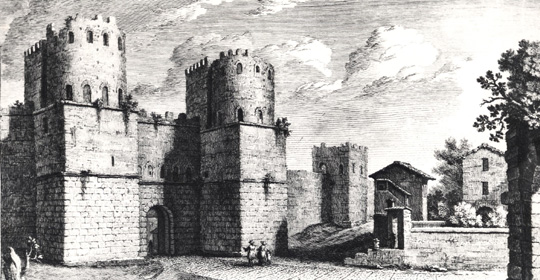
The second park we visited is also along an ancient road, the Appia Antica, or Appian Way. This road leads out of the city heading South from Porta San Sebastiano and was built shortly after the Via Latina in 312 BC. I didn't get any pictures that day, but I have some from a previous day when John and I visited the museum of the walls at Porta San Sebastiano.
This gate is pretty impressive, especially compared to some of the others. The Porta Latina is much smaller and not as elaborate.

Arco di Druso just inside the gate.

This shows the walkway on the inside of the wall. Along the outside wall there are arrow slits where you can look out over the southern suburbs.


Here we are on top of the gate looking down on the Appia Antica. Yes, parts of the 2500 year old road is still used today. A little further down the ancient road goes through the park and the cars go along a newer roadway. Although new is relative around here. There are Medieval buildings along the sides of the road, so not exactly modern.

This part of the city is pock marked with catacombs, the underground burial chambers of early Christians dating from the second century. We visited the Catacombs of San Callixtus. Photography was not allowed inside. But there are some at the catacomb website. The catacombs were in use for about 300 years. During this time around half a million people were buried here including popes and martyrs. The catacombs were closed and abandoned because of the barbarian invasions. In the 16th century the excavation and exploration of the catacombs began and it continues today. It was only 20 years ago that the bodies located in the public areas were removed because the bones were leaving with the pilgrims and tourists who came to visit.
It was amazing to walk along the corridors and see the niches stacked up. It's a lot of people from a very long time ago.

(source)
Parts of the catacombs are richly decorated with carved stone and frescoes. There are a lot of Christian symbols in the carvings and paintings. I don't have photos of the interior, but I have photos of the post cards I bought that day.


We also made a quick visit to a small urban park on top of the Aventino, It is the Giardino degli Aranci, the garden of the oranges. The Aventine hill is one of the seven hills of Rome and is between the Paletine hill and the Tiber river. It gets its name from the orange trees planted there, but people go for the spectacular view over the river looking northeast toward the Vatican.


Another day, another sunset at a beautiful Roman park. Life is good.

No comments:
Post a Comment