Monday, January 27, 2020

Staycation: Happy New Year!


Happy New Year!  Buon Feste!

Rome celebrates the end of the year in a big way.  There is a massive 24 hour party in and around Circo Massimo.  It all starts on New Years Eve with concerts, light shows, fireworks and crowds numbering in the hundreds of thousands.  We aren't really crowd people so we celebrated at home with a few late night adventures in pyrotechnics and also watched the neighbors'.  From our balcony we could see a couple of pretty good displays.  We face the wrong way to see the fireworks downtown.  I think one of them might have been coming from Cinecitta.  Cinecitta (Movie city) is a movie studio turned amusement theme park, maybe a bit like Universal Studios.

I think it is an interesting side note that American celebrate the New Year and Italians celebrate the Capodanno, which can be translated as end of the year, but more literally the head of the year,  Is there some cultural commentary that could be made here?  I don't know.

The next evening we went out to explore the city a little bit.  The kids got tired so we sent them home on the Metro and John and I walked south along the river.  We started to see some cool things like lights and video projections on the sides of buildings including the hospital on Tiber island.  It was pretty cool.  We decided to check it out.  I didn't realize that the party was still going on from the night before.  It was perfect.  Enough people around to feel festive, but not so many that it was problematic.


By this time the concerts were over, but we still got to see some of the art displays and light shows.  We saw a couple of little mini parades of performers.  The first one we saw was fish and sea themed.  It was far off so I didn't get a good photo.  They were headed toward the building with the purple octopus tentacles growing out the side.


Then we saw a bird themed performance coming up behind us.  So impressive.


After the birds passed we followed the lights and flames up the Aventine hill and saw a spectacular view of the city.


This little street was lit with burning lanterns on one side and hanging paper lanterns around the corner.  There were still plenty of people, but something about the flames made it more subdued.  We walked up through the Gardine degli Arancia.  The view is just as spectacular at night and especially tonight with all of the lights.  The garden looked like a fairy land with the trees covered in lights.  There was a little platform with a piano available to anyone who wanted to play.  Perhaps there had been performances here earlier.  There was also a big glowing water bear/tardigrade.  I'm not sure what that was about.  It was very otherworldly.

Just outside the garden is the Basilica di Santa Sabina all' Aventino. (and here)  There were only a couple other people inside including the priest.  It was dark and quiet and beautifully spare.  So many of the churches are extremely ornate in the style of the 16-17th centuries.  This basilica was built on or near the site of a Roman temple to Juno.  The columns inside are said to have originally been part of that temple.

 These carved stone panels reminded me of Ireland and Celtic decorations.


You could put a coin in a machine to turn the lights on in the side chapels.  These were more richly decorated.

 The famous doors and one of the surviving mosaics.


It was a magical evening. 


Sunday, January 26, 2020

Staycation: Layers of history

Something that never ceases to amaze me is the incredible layering of history here in Rome.  This spot has been in continual habitation for nearly 2800 years.  That's a lot of years and a lot of building and rebuilding.  It hasn't stopped.  The Capitoline hill at the head of the Roman Forum was rebuilt in the early 20th century with the Monumento Nazionale a Vittorio Emanuele II, or the wedding cake, or typewriter if you prefer.  Before that there were ancient, Renaissance, and Medieval buildings on site.  The piazza is bordered on the north by a recently refurbished palace once occupied by Napoleon Bonaparte's mother.  The palace is now a museum currently featuring an exhibit of Impressionist artists upstairs and Legos downstairs.  Piazza Venezia and the surrounding streets are changing once again to make way for a new Metro station.  It never ends.


Late one night after the kids were in bed we went for a walk.  We headed up along the Aurelian wall and through the Porta Latina.  We saw a sign for the Basilica di San Giovanni a Porta Latina.  We knew the Basilica di San Giovanni in Laterano.  It is in the same general direction as the sign and we thought the road might go through.  Nope.  Different Basilica di San Giovanni.  It was late and the church was closed, but it was really interesting to look at the outside architecture.  You can see how they used mismatched Roman columns and added a bell tower after the main part of the Medieval church was built.  The church was built around 490 AD and restored in the 8th and 12th centuries and most recently in about 1940.  I'm sure at some point it will need fixing up again.

In November John and I stumbled across a concert at the Basilica di San Giovanni e Paulo al Celio.  It was lovely.  The original church was built in 398 over the house of two Roman soldiers martyred in 362.  The church was damaged and rebuilt many times through the centuries with a later addition of a monastery and bell tower.  In the 19th century more excavations were done and the original Roman houses were discovered underneath the church.  The older one dates to about 111.  The houses are now open as a small museum.  It is amazing and especially fun when you have it mostly to yourself.


Many wall frescoes and floor mosaics are quite intact.  There is a part where you can see what was once a road between buildings, now covered over.

mosaic floor

fresco in the nymphaeum


So much to see and learn.

Sunday, January 19, 2020

Staycation: parks of Rome


Many of the parks in the city are the grounds of former villas that are now public.  This week we visited two large parks that are further out.  The first one is the Parco degli Acuedotti (and here) located South and East of the city center.  It isn't that far away, but it feels delightfully wild after being in the concrete urban jungle for awhile.  Not that long ago this area was wild.  The buildings in the surrounding neighborhood were built during the post WWII suburban building boom.  But true to form this park includes an ancient villa, Villa delle Vignacce, Villa of the vineyards, built in the 2nd century and restored in the 4th century.  More recent 21st century excavations revealed mosaics, baths, and an underground heating system.


The stars of the park are the aqueducts which were used to carry water into the city.  There are three running through the park in various states of disrepair.  One of them was partly dismantled by Pope Sixtus to build a different aqueduct in another part of the city.


Parts of the Via Latina are still visible in the park, one of the oldest Roman roads.  This ancient road leads out of the city from the Porta Latina.  Porta Latina is a smaller gate in the old city walls near our house and just south of the Baths of Caracalla.  My Boy walks through this gate on his way home from school.

We were there at sunset, which was a beautiful time of day.  I really enjoy the winter light.  It is a lot like winter in California, just a little bit colder.  The November rains have stopped and the spring rain hasn't started yet, so it's gorgeous.


This is not a black and white photo.  For some reason it makes me think of Lemony Snicket.


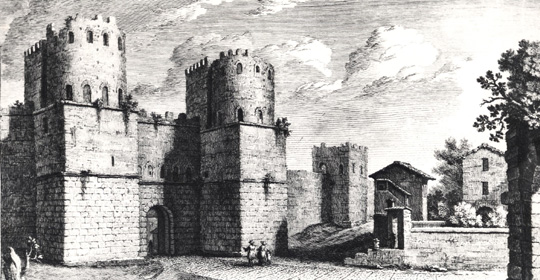
The second park we visited is also along an ancient road, the Appia Antica, or Appian Way.  This road leads out of the city heading South from Porta San Sebastiano and was built shortly after the Via Latina in 312 BC.  I didn't get any pictures that day, but I have some from a previous day when John and I visited the museum of the walls at Porta San Sebastiano.

This gate is pretty impressive, especially compared to some of the others.  The Porta Latina is much smaller and not as elaborate.

Vases, engraving

Arco di Druso just inside the gate.


This shows the walkway on the inside of the wall.  Along the outside wall there are arrow slits where you can look out over the southern suburbs.


Here we are on top of the gate looking down on the Appia Antica.  Yes, parts of the 2500 year old road is still used today.  A little further down the ancient road goes through the park and the cars go along a newer roadway.  Although new is relative around here.  There are Medieval buildings along the sides of the road, so not exactly modern.


This part of the city is pock marked with catacombs, the underground burial chambers of early Christians dating from the second century.  We visited the Catacombs of San Callixtus.  Photography was not allowed inside.  But there are some at the catacomb website.  The catacombs were in use for about 300 years.  During this time around half a million people were buried here including popes and martyrs.  The catacombs were closed and abandoned because of the barbarian invasions.  In the 16th century the excavation and exploration of the catacombs began and it continues today.  It was only 20 years ago that the bodies located in the public areas were removed because the bones were leaving with the pilgrims and tourists who came to visit.

It was amazing to walk along the corridors and see the niches stacked up.  It's a lot of people from a very long time ago.


Parts of the catacombs are richly decorated with carved stone and frescoes.  There are a lot of Christian symbols in the carvings and paintings.  I don't have photos of the interior, but I have photos of the post cards I bought that day.


We also made a quick visit to a small urban park on top of the Aventino,  It is the Giardino degli Aranci, the garden of the oranges. The Aventine hill is one of the seven hills of Rome and is between the Paletine hill and the Tiber river.  It gets its name from the orange trees planted there, but people go for the spectacular view over the river looking northeast toward the Vatican.


Another day, another sunset at a beautiful Roman park.  Life is good.

Sunday, January 12, 2020

Winter break staycation: Vatican and Castel Sant'Angelo


We had plans for winter break that included getting out of town.  Even though we live in an incredibly beautiful city, I wanted to see something else.  We had plans to visit John's sister in France.  We dreamt of baguettes and chocolate croissants, but it wasn't meant to be.  Over the holidays France was in the middle of a nationwide transportation strike.  Over a month later it is still unresolved.  There is a stand-off over the possibility of pension reform.  The French do love their unsustainable pensions.  With no reliable trains running from Lyon to my sister-in-law's town we tried a rental car.  No luck.  We couldn't get one.  We heard later that getting gas was iffy since the protesters were blocking refineries.  With no way to get where we wanted to go we just decided to be "flexible" and go another time.  We looked into Croatia and other places, but in the end stayed home.  This is, after all, one of the most visited cities in the world.  Why leave, right?

The decision to stay home brought a sigh of relief from the kids.  Recently I learned a word that describes them pretty well on most days.  Pantofolaio.
Pantofolaio comes from the word pantofola which means slipper. By adding the agent suffix -aio to the end, you wind up with a word that means “someone who wears slippers all the time”. People in this category prefer to stay at home on the couch watching TV rather than go out and see new things.
My girl likes to go do things, but neither is all that interested in going out to see things, especially things like big piles of old rocks.  So what did we do over the break?  We went out and looked at piles of old rocks.  Often.  We threw in a few newer rocks and some underground rocks just for fun.  To be fair, after we finally get out of the house, they have a good time, but they are more than happy to get back home.

Buddy Boy and I headed up to Piazza San Pietro to see the Vatican nativity.  We hadn't been there at all before.  The whole thing is quite impressive.  We'll need a whole day to see the Vatican museums.  We'll tackle that one another time.

 Piazza San Pietro


Each year the Nativity or presepe is done in the traditional style of a different region of Italy.  This year it is Valsugana in Trentino.  This is near the northern border with Austria.


After seeing the big one we stopped into the exhibit of 100 presepi.  It was fun to see all of the different materials, wood, straw, stone, paper, and even pasta.


Pasta presepe

 Traditional presepe

Italians claim to have originated the Presepe.  Maybe in Naples.  Maybe one of the several other places making the same claim.  The traditional presepe have a specific style with very elaborate sets.


 "Really mom, will you PLEASE stop taking pictures?"


We were back a few days later with the whole family.


This time we added Castel Sant'Angelo to the itinerary when we saw that it was free entrance day and, more importantly, almost no line.  It is a perfect example of the layering of history in Rome.  The building originated as a tomb for the Roman Emperor Hadrian in 123 AD.  It later became a military stronghold as layer upon layer was added, including an escape passage from the Vatican in case of siege.  Later additions included lavish papal apartments with frescoes decorated by the Renaissance master, Rafael.


 Why yes, that is a catapult with piles of stone shot.

 Statue commemorating a papal vision of St. Micheal the Archangel sheathing his sword signalling the end a 6th century plague.

 View of the Vatican from the top.


Gorgeous winter days.  Life is good.